Aerodynamics
aircraftdetective.calculations.aerodynamics 
compute_aspect_ratio 
compute_aspect_ratio(df)Given the wingspan \(b\) and the wing area \(S\), returns the aspect ratio \(A\) of an aircraft. $$ A = \frac{b^2}{S} $$ where
| Symbol | Dimension | Description |
|---|---|---|
| \(A\) | - | Aspect ratio |
| \(b\) | [length] | Wingspan |
| \(S\) | [area] | Wing area |
References
See Also
Parameters:
| Name | Type | Description | Default | ||||||
|---|---|---|---|---|---|---|---|---|---|
df
|
DataFrame
|
|
required |
Returns:
| Type | Description |
|---|---|
DataFrame
|
|
Raises:
| Type | Description |
|---|---|
ValueError
|
If the input DataFrame does not contain the required columns. |
Example
import pandas as pd
from aircraftdetective.calculations.aerodynamics import compute_aspect_ratio
df = pd.DataFrame(
    {
        'Wingspan': pd.Series([60.3, 64.8], dtype='pint[m]'),
        'Wing Area': pd.Series([361, 443], dtype='pint[m**2]'),
    }
)
compute_aspect_ratio(df=df)Source code in aircraftdetective/calculations/aerodynamics.py
def compute_aspect_ratio(
    df: pd.DataFrame,
) -> pd.DataFrame:
    r"""
    Given the wingspan $b$ and the wing area $S$, returns the aspect ratio $A$ of an aircraft.
    $$
    A = \frac{b^2}{S}
    $$
    where

    | Symbol | Dimension | Description  |
    |--------|-----------|--------------|
    | $A$    | -         | Aspect ratio |
    | $b$    | [length]  | Wingspan     |
    | $S$    | [area]    | Wing area    |


    References
    ----------
    [Eqn. (3.3) in Young (2018)](https://doi.org/10.1002/9781118534786)

    See Also
    --------
    [Aspect Ratio on Wikipedia](https://en.wikipedia.org/wiki/Aspect_ratio_(aeronautics))


    Parameters
    ----------
    df : pd.DataFrame
        [`pint-pandas`](https://pint-pandas.readthedocs.io/en/latest/) DataFrame containing the columns:

        | Column Name | Dimension  |
        |-------------|------------|
        | `Wingspan`  | [length]   |
        | `Wing Area` | [area]     |

    Returns
    -------
    pd.DataFrame
        [`pint-pandas`](https://pint-pandas.readthedocs.io/en/latest/) DataFrame with an additional column `Aspect Ratio` [dimensionless] added.

    Raises
    ------
    ValueError
        If the input DataFrame does not contain the required columns.

    Example
    -------
    ```pyodide install='aircraftdetective'
    import pandas as pd
    from aircraftdetective.calculations.aerodynamics import compute_aspect_ratio
    df = pd.DataFrame(
        {
            'Wingspan': pd.Series([60.3, 64.8], dtype='pint[m]'),
            'Wing Area': pd.Series([361, 443], dtype='pint[m**2]'),
        }
    )
    compute_aspect_ratio(df=df)
    ```
    """
    df_func = df.copy()
    required_columns = ['Wingspan', 'Wing Area']
    missing_columns = [col for col in required_columns if col not in df_func.columns]
    if missing_columns:
        raise ValueError(f"DataFrame is missing required columns: {missing_columns}")
    df_func['Aspect Ratio'] = (df_func['Wingspan']**2) / df_func['Wing Area']
    df_func['Aspect Ratio'] = df_func['Aspect Ratio'].pint.to_base_units()
    return df_func
compute_lift_to_drag_ratio 
compute_lift_to_drag_ratio(df, beta)Given points from a payload/range diagram of an aircraft, calculates the lift-to-drag ratio (=aerodynamic efficiency) based on the Breguet range equation.
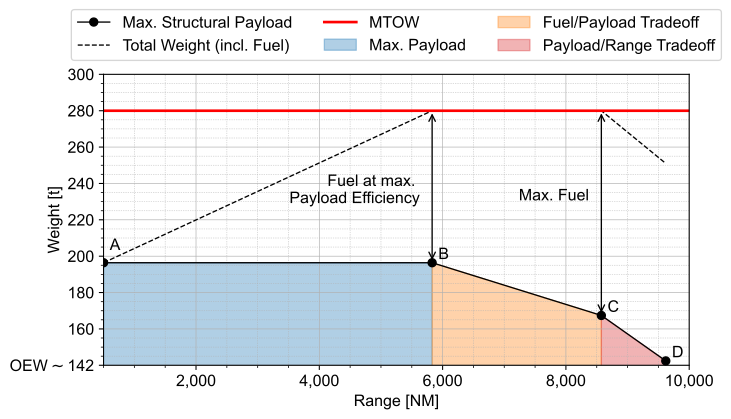 Figure 1: Payload/Range diagram of the Airbus A350-900 (data derived from manufacturer information).
Note that in this figure, the y-axis shows total aircraft weight, not payload weight.
Total aircraft weight can be computed by adding the operating empty weight (OEW) to the payload weight and fuel weight.
Figure 1: Payload/Range diagram of the Airbus A350-900 (data derived from manufacturer information).
Note that in this figure, the y-axis shows total aircraft weight, not payload weight.
Total aircraft weight can be computed by adding the operating empty weight (OEW) to the payload weight and fuel weight.
The range equation for a jet aircraft can be written as $$ R = \frac{V}{c \cdot g} \frac{L}{D} \ln \bigg( \frac{m_1}{m_2} \bigg) $$ where
| Symbol | Unit | Description |
|---|---|---|
| \(R\) | m | Aircraft range |
| \(V\) | m/s | Cruise speed |
| \(c\) | g/kNs | Thrust-specific fuel consumption (average) |
| \(g\) | m/s\(^2\) | Acceleration due to gravity |
| \(L/D\) | - | Lift-to-drag ratio |
| \(m_1\) | kg | weight at start of cruise segment |
| \(m_2\) | kg | weight at end of cruise segment |
The right hand side is composed of the logarithmic weight ratio term and a term also known as the range factor \(K\): $$ K = \frac{V}{c \cdot g} \frac{L}{D} $$ which is
(...) assumed to be constant during the cruise phase, represents an average performance of the aircraft and is related to the mean aerodynamic and propulsion characteristics (...)
— Martinez-Val et al. (2008)
The masses \(m_1\) and \(m_2\) can be expressed in terms of the maximum takeoff weight (MTOW) and the maximum zero fuel weight (MZFW) as $$ \frac{m_1}{m_2} \propto \frac{(1-\beta)MTOW}{OEW + \text{Payload}} = \frac{(1-\beta)MTOW}{MZFW} $$ where the correction factor \(\beta\)
(...) accounts for the fuel fractions burnt during the take-off and climbing phases (...), the fuel fractions burnt during the descent and landing phases (...) [and] the reserve fuel.
— Martinez-Val et al. (2008)
With that, the lift-to-drag ratio can be computed as $$ \frac{L}{D} = \frac{K \cdot g \cdot TSFC_{cruise}}{V} = \frac{R \cdot g \cdot TSFC_{cruise}}{V \ln(\frac{MTOW}{MZFW} (1-\beta))} $$ where
| Symbol | Unit | Description |
|---|---|---|
| \(MTOW\) | [kg] | Maximum takeoff weight |
| \(MZFW\) | [kg] | Maximum zero fuel weight |
| \(\beta\) | - | Correction factor for the Breguet range equation |
See Also
Parameters:
| Name | Type | Description | Default | ||||||||||||||
|---|---|---|---|---|---|---|---|---|---|---|---|---|---|---|---|---|---|
df
|
DataFrame
|
|
required | ||||||||||||||
beta
|
dict[str, float]
|
Correction factor for the Breguet range equation, typically between 0.4 and 0.6. |
required |
Returns:
| Type | Description |
|---|---|
DataFrame
|
|
Raises:
| Type | Description |
|---|---|
ValueError
|
If the input DataFrame does not contain the required columns, or if |
Example
Source code in aircraftdetective/calculations/aerodynamics.py
def compute_lift_to_drag_ratio(
df: pd.DataFrame,
beta: dict[str, float],
) -> pd.DataFrame:
r"""
Given points from a payload/range diagram of an aircraft,
calculates the lift-to-drag ratio (=aerodynamic efficiency)
based on the Breguet range equation.

**Figure 1:** Payload/Range diagram of the Airbus A350-900 (data derived [from manufacturer information](https://web.archive.org/web/20211129144142/https://www.airbus.com/sites/g/files/jlcbta136/files/2021-11/Airbus-Commercial-Aircraft-AC-A350-900-1000.pdf)).
Note that in this figure, the y-axis shows _total_ aircraft weight, not _payload weight_.
Total aircraft weight can be computed by adding the operating empty weight (OEW) to the payload weight and fuel weight.
The range equation for a jet aircraft can be written as
$$
R = \frac{V}{c \cdot g} \frac{L}{D} \ln \bigg( \frac{m_1}{m_2} \bigg)
$$
where
| Symbol | Unit | Description |
|--------|-------------|--------------------------------------------|
| $R$ | m | Aircraft range |
| $V$ | m/s | Cruise speed |
| $c$ | g/kNs | Thrust-specific fuel consumption (average) |
| $g$ | m/s$^2$ | Acceleration due to gravity |
| $L/D$ | - | Lift-to-drag ratio |
| $m_1$ | kg | weight at start of cruise segment |
| $m_2$ | kg | weight at end of cruise segment |
The right hand side is composed of the logarithmic weight ratio term and a
term also known as the range factor $K$:
$$
K = \frac{V}{c \cdot g} \frac{L}{D}
$$
which is
> (...) assumed to be constant during the cruise phase,
> represents an average performance of the aircraft
> and is related to the mean aerodynamic and propulsion characteristics (...)
> — [Martinez-Val et al. (2008)](https://doi.org/10.1243/09544100JAERO338)
The masses $m_1$ and $m_2$ can be expressed in terms of the maximum takeoff weight (MTOW)
and the maximum zero fuel weight (MZFW) as
$$
\frac{m_1}{m_2} \propto \frac{(1-\beta)MTOW}{OEW + \text{Payload}} = \frac{(1-\beta)MTOW}{MZFW}
$$
where the correction factor $\beta$
> (...) accounts for the fuel fractions burnt during the take-off and climbing phases (...),
> the fuel fractions burnt during the descent and landing phases (...)
> [and] the reserve fuel.
> — [Martinez-Val et al. (2008)](https://doi.org/10.1243/09544100JAERO338)
With that, the lift-to-drag ratio can be computed as
$$
\frac{L}{D} = \frac{K \cdot g \cdot TSFC_{cruise}}{V} = \frac{R \cdot g \cdot TSFC_{cruise}}{V \ln(\frac{MTOW}{MZFW} (1-\beta))}
$$
where
| Symbol | Unit | Description |
|--------------------|-----------------|--------------------------------------------------|
| $MTOW$ | [kg] | Maximum takeoff weight |
| $MZFW$ | [kg] | Maximum zero fuel weight |
| $\beta$ | - | Correction factor for the Breguet range equation |
References
----------
- [Young (2018), Eqn. (13.36)](https://doi.org/10.1002/9781118534786)
- [Martinez-Val et al. (2008)](https://doi.org/10.1243/09544100JAERO338)
- [Martinez-Val et al. (2005)](https://doi.org/10.2514/6.2005-121)
See Also
--------
[Range (aeronautics) on Wikipedia](https://en.wikipedia.org/wiki/Range_(aeronautics))
Parameters
----------
df : pd.DataFrame
[`pint-pandas`](https://pint-pandas.readthedocs.io/en/latest/) DataFrame containing the columns:
| Column Name | Dimension |
|-----------------------------------|---------------------|
| `Payload/Range: Range at Point B` | [length] |
| `Payload/Range: Range at Point C` | [length] |
| `Payload/Range: MZFW at Point B` | [mass] |
| `Payload/Range: MZFW at Point C` | [mass] |
| `Cruise Speed` | [length/time] |
| `TSFC (cruise)` | [mass/(force*time)] |
beta : dict[str, float]
Correction factor for the Breguet range equation, typically between 0.4 and 0.6.
Specific to aircraft type, e.g.:
```python
beta = {
    'Narrow': 0.06,
    'Wide': 0.04,
}
```
Returns
-------
pd.DataFrame
[`pint-pandas`](https://pint-pandas.readthedocs.io/en/latest/) DataFrame with an additional column `L/D` [dimensionless] added.
Raises
------
ValueError
If the input DataFrame does not contain the required columns, or if `beta` is not between 0 and 1.
Example
-------
```pyodide install='aircraftdetective'
```
"""
if df.empty:
raise ValueError("DataFrame is empty.")
_validate_dataframe_columns_with_units(
df,
{
'Payload/Range: Range at Point B': '[length]',
'Payload/Range: Range at Point C': '[length]',
'Payload/Range: MZFW at Point B': '[mass]',
'Payload/Range: MZFW at Point C': '[mass]',
'Payload/Range: MTOW': '[mass]',
'Cruise Speed': '[length]/[time]',
'TSFC (cruise)': '[time]/[length]',
}
)
if 'Type' not in df.columns:
raise ValueError("The DataFrame must contain a 'Type' column when `beta` is a dict.")
df_func = df.copy()
beta_series = df_func['Type'].map(beta)
if beta_series.isna().any():
missing_types = sorted(df_func.loc[beta_series.isna(), 'Type'].astype(str).unique())
raise ValueError(f"Missing beta for Type(s): {missing_types}. Provide all required mappings.")
if not ((beta_series > 0) & (beta_series < 1)).all():
bad_rows = beta_series.index[~((beta_series > 0) & (beta_series < 1))]
raise ValueError(f"`beta` values must be between 0 and 1 for all rows. Bad indices: {list(bad_rows)}")
K_B: pd.Series = df_func['Payload/Range: Range at Point B'] / np.log(
(df_func['Payload/Range: MTOW'] / df_func['Payload/Range: MZFW at Point B']) * (1 - beta_series)
)
K_C: pd.Series = df_func['Payload/Range: Range at Point C'] / np.log(
(df_func['Payload/Range: MTOW'] / df_func['Payload/Range: MZFW at Point C']) * (1 - beta_series)
)
K_average = (K_B + K_C) / 2
df_func['L/D'] = K_average * g_acceleration * df_func['TSFC (cruise)'] / df_func['Cruise Speed']
df_func['L/D'] = df_func['L/D'].pint.to_base_units()
if not df_func['L/D'].pint.units.dimensionless:
raise ValueError("Calculated L/D is not dimensionless, please check the input units.")
return df_func